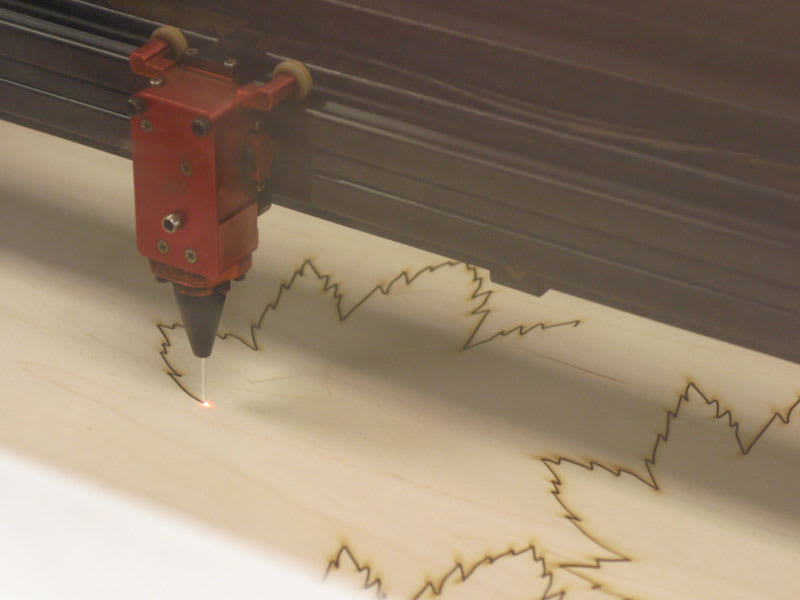
Laser is an acronym for “Light Amplification by Stimulated Emission of Radiation”. Simply put, light is amplified and radiated. The difference is the method used to magnify the light determines the type of laser itself.
The difference between diode and CO2 lasers
Diode lasers are also called semiconductors lasers, as they use semiconductors. Light is emitted by passing current through a semiconductor then a lens, and that light is used for various applications. They are widely used in our daily lives from laser printers to optic disks, such as DVD’s CD’s etc. Diode lasers have the advantage of being small and are low voltage, low current, and therefore are often mounted on small laser cutters and CNC machines.
The CO2 laser is one of the earliest gas lasers. Developed by Kumar Patel in 1964, and it is still one of the most useful lasers today. With its high power and levels of control, CO2 lasers can be used for applications requiring precision, mass production, and most importantly, personalization. CO2 laser engravers and cutters are highly precise and can be used to create designs, decorations and the like on just about any material you can think of, including wood, plastic, metal and paper.
How CO2 lasers work
The light produced is very powerful compare to normal light, because the tube of gasses is surrounded by mirrors, which reflect most of the light traveling through the tube. This reflection of the light causes the light waves being produced by the CO2 to build in intensity. The light increases as it travels back and forth through the tube, only coming out after becoming bright enough to pass through the partially reflective mirror.
Although the highest-powered CO2 laser runs over 1000W, those used for machining, are generally between 25W-100W; by comparison, laser pointers are a few thousandths of a watt. Because it is in the infrared, it has a very long wavelength, around 10.6 micrometers; it is much longer than visible light, which runs between 450 and 700 nanometers. As continuous lasers go, the CO2 type is the most powerful in production.
What materials work with CO2 laser cutter/engraver machines
All the machines in this review will engrave and cut the same materials but at different thicknesses.
Cutting:
Wood
Acrylic
Plastic
Leather
Fabrics
MDF
Rubber
Fiberglass
Foam
Corian
Paper
Cardboard
Engraving:
Metal *
Stone
Wood
Tile
Acrylic
Plastic
Leather
Fabrics
Glass
Melamine
Phenolic
Rubber
Cork
* Coated metal, anodized aluminum, and painted metal